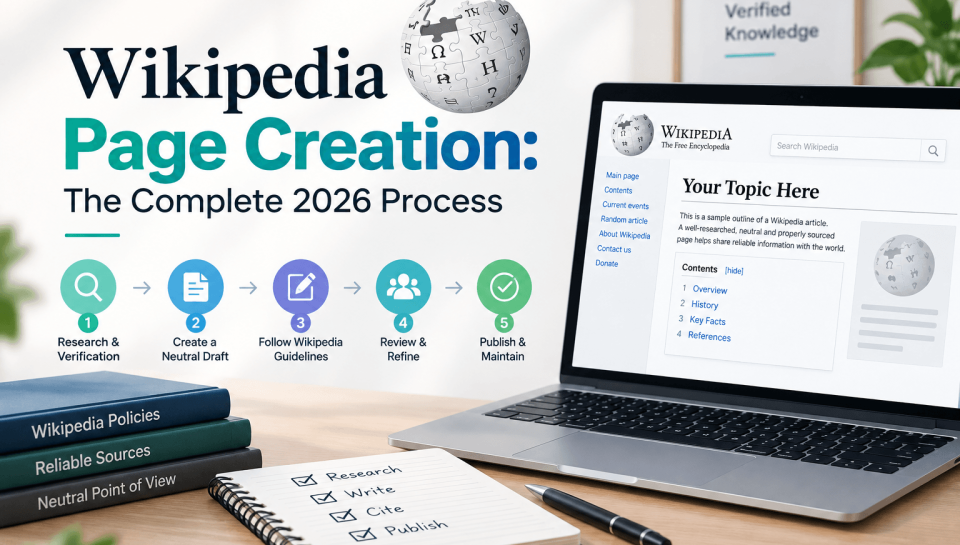
Wikipedia page creation is the process of drafting a new encyclopedia article and getting it accepted by Wikipedia’s volunteer editors. It has four parts: confirming the subject meets Wikipedia’s notability standard, assembling independent published sources, writing a neutral draft from those sources, and submitting it through Articles for Creation. Creating a page is free. The hard part is qualifying, not publishing — and roughly speaking, if the independent coverage doesn’t already exist, no draft will survive.
- Notability is the gate. A subject needs significant coverage in multiple reliable sources independent of it. Revenue, follower count, and job title are irrelevant.
- Company pages are held to a stricter standard than people. Wikipedia’s organizations guideline explicitly raises the bar on source quality to stop marketers gaming it.
- You need an account that’s at least 4 days old with 10+ edits to create an article directly. Almost everyone should use Articles for Creation instead anyway.
- Paid disclosure is mandatory, not optional, under the Wikimedia Foundation’s Terms of Use — for you, your agency, and your PR firm.
- AI-written drafts are now prohibited. Since March 2026, Wikipedia’s LLM guideline bans using large language models to generate or rewrite article content, and blatant cases qualify for immediate deletion.
- Expect 1–4 months in the review queue, sometimes longer. There is no way to pay for priority.
Step 1: Find out whether the subject qualifies
Everything else is wasted effort if this step fails. Wikipedia’s general notability guideline asks for significant coverage in reliable sources that are independent of the subject.
| Requirement | What it means | Passes | Fails |
| Significant | The source discusses the subject directly and in depth | A reported 1,200-word profile | A one-line mention in a roundup |
| Reliable | A publication with editorial oversight and fact-checking | Reuters, The Wall Street Journal, an academic press | A blog, a content farm, a syndication network |
| Independent | Not produced by, paid for, or derived from the subject | A journalist’s own reporting | A press release, an advertorial, an interview |
| Multiple | A pattern of coverage | Four substantial pieces across three outlets | One news cycle endlessly re-aggregated |
| Secondary | Analyzes or interprets, rather than simply records | A trade journal’s analysis of your product’s market impact | An SEC filing, your own website |
Wikipedia is explicit that routine news coverage — press releases, public announcements, and reporting that offers no critical analysis — does not count as significant coverage, no matter how much of it there is.
Companies are judged more harshly than people
This is the single most common misunderstanding, and it deserves its own section.
Wikipedia’s organizations and companies guideline (editors call it NCORP) applies the same general test but, in its own words, places a stronger emphasis on source quality specifically to prevent the rules being gamed by marketing and public relations professionals. In practice, that means:
- Two-pronged independence. Both the publisher and the content must be independent. An article built from your press release, or from an interview with your CEO, isn’t independent content even if it appears in a respected outlet.
- Funding rounds and earnings are routine. A Series B announcement covered by twenty outlets typically establishes nothing, because all twenty derive from the same announcement.
- Trade press is weaker than people expect. Coverage in a publication whose business depends on your industry is often treated as insufficiently independent.
- Notability isn’t inherited. A notable founder does not make the company notable, and vice versa. Each subject is assessed separately.
- Being large isn’t enough. Wikipedia’s guideline notes that notability is never automatic — though for publicly traded companies, sufficient independent coverage usually does exist, so the task becomes finding it rather than manufacturing it.
A 15-minute qualification audit
- List every piece of published coverage about the subject.
- Delete anything sponsored, syndicated, or pitched as branded content.
- Delete anything that’s substantially the subject’s own words (interviews, Q&As, quotes).
- Delete anything derived from a press release or announcement.
- Delete anything shorter than a few hundred words about the subject specifically.
- Delete directories, databases, and listings — Wikipedia explicitly discounts mass-edited databases like IMDb as notability evidence.
If three to five substantial items survive, you have a case worth building. If one or two do, wait. Reviewer expectations vary; some accept three well-researched in-depth pieces, others want five to ten, and the reputation of the outlet carries real weight.
Step 2: Check what already exists
Before drafting, search Wikipedia thoroughly:
- The subject’s name and every variant — legal name, trading name, former name, common misspellings.
- The deletion log. If an article was deleted before, read the deletion discussion. Recreating it on the same sourcing can be deleted on sight.
- Related articles. If the subject appears as a red link in an existing article, or is already covered in a paragraph elsewhere, a merge or expansion may be the correct outcome rather than a standalone page.
For context on scale: English Wikipedia passed seven million articles in May 2025, and there are more than 66 million articles across all languages. The thing you want to write about may already be covered under a name you didn’t think to search.
Step 3: Pick your creation route
There are three ways to get an article onto Wikipedia, and choosing the wrong one is a common own goal.
| Route | How it works | Who should use it |
| Articles for Creation (AfC) | Build a draft at Draft: Subject Name, submit for volunteer review, revise on feedback | Almost everyone — and effectively mandatory if you have any connection to the subject |
| Direct mainspace creation | Create the article yourself via the Article Wizard or a red link | Experienced editors writing about unrelated subjects |
| Requested articles | Add the subject to Wikipedia’s requested-articles list with sources and wait | Anyone whose subject is notable but who’d rather not write it |
Direct creation requires an autoconfirmed account — on English Wikipedia, an account at least four days old with at least ten edits. But permission isn’t the real issue. If you have a conflict of interest and publish straight to the encyclopedia, you’re inviting a deletion nomination and a talk-page investigation. AfC exists precisely so a neutral volunteer signs off first, and using it is the strongest signal of good faith you can send.
Step 4: Disclose your connection before you write anything
Two separate obligations apply, and people routinely conflate them.
Conflict of interest (COI). If you’re writing about yourself, your employer, your client, your family member, or anything you have a personal stake in, you have a COI. Wikipedia strongly discourages editing in that situation and asks you to declare it.
Paid contributions. If anyone receives or expects compensation for the edit, disclosure is mandatory. The Wikimedia Foundation’s Terms of Use require every editor to disclose their employer, client, and affiliation for any compensated contribution. That disclosure must appear in at least one of three places: a statement on your user page, the edit summary accompanying each paid contribution, or the article’s talk page.
This covers your marketing manager, your PR agency, and the freelancer you found online. The Foundation’s own guidance is clear that if you hire someone and they don’t disclose, they’re violating the Terms of Use. Undisclosed paid editing reliably produces deletion, a block, and sometimes press coverage — the opposite of what the page was meant to achieve.
Do it before you start editing. Disclosing after a reviewer confronts you reads very differently than disclosing up front.
Step 5: Build the source dossier, then write from it
Experienced editors build a source table before writing a sentence. For each source, record: publication, author, date, URL, and — the important column — which specific factual claims it supports.
This exposes the real problem with most drafts. If eight of your ten sources support the founding date and none support anything about significance, you don’t have an article. You have a company profile with footnotes.
Write only what the sources support. Every sentence in a Wikipedia article should survive the question Who says so?
Step 6: Write it like an encyclopedia, not a website
Promotional tone is the single most common reason otherwise-eligible drafts get declined.
| Promotional draft | Encyclopedic version |
| A leading provider of innovative cloud solutions | A cloud storage company founded in 2019 in Austin, Texas |
| Has revolutionized how teams collaborate | TechCrunch described the product as an early entrant in asynchronous team messaging |
| Trusted by the world’s top brands | Customers have included Delta Air Lines and Target |
| Widely recognized as an industry pioneer | — cut; no independent source supports this |
A standard article structure:
- Lead — two to four sentences covering what the subject is and why it’s significant. No adjective you can’t cite.
- History / Early life — sourced, chronological, factual.
- Operations / Career — what the subject does, as described by independent sources.
- Reception / Reviews — what critics, analysts, and journalists concluded.
- Controversies — if reliable sources have covered them. Omitting them is a tell, and someone else will add them later in harsher language than you’d have used.
- References — inline citations for every non-obvious claim.
Also avoid: copying text from any website (that’s a copyright violation and a fast decline), listing products and pricing, linking to your store, and writing anything that reads like a résumé or a capabilities deck.
Step 7: Know the 2026 rules that most guides haven’t caught up with
This is where older advice actively harms you.
AI-generated drafts are prohibited. On 20 March 2026, English Wikipedia adopted a guideline on writing articles with large language models. It passed 44 to 2 and bans using LLMs to generate or rewrite article content, on the reasoning that LLM-generated text routinely violates core content policies. Two narrow exceptions survive: basic copyediting of text you wrote yourself, and first-pass translation under a separate guideline.
Blatant cases get deleted immediately. Speedy-deletion criterion G15, adopted in August 2025, lets an administrator delete an obviously LLM-generated page on sight, with no seven-day discussion. The triggers are deliberately objective: text clearly addressed to whoever prompted the model, and implausible or non-existent references.
Reviewer logs now show drafts routinely declined with the reason code ai after waiting two or three months in the queue. If a vendor’s workflow is “generate, lightly edit, submit,” you’re buying something with a high chance of deletion. Using AI to organize your source list or summarize articles you’ve read is a different matter — the restriction is on generated article prose.
Step 8: Submit, then wait properly
- Finish the draft in Draft space.
- Confirm your COI or paid disclosure is already posted.
- Submit via the AfC template.
- Leave it alone. Resubmitting an unchanged draft to jump the queue is counterproductive.
- When feedback arrives, respond on the draft’s talk page — not by arguing on the reviewer’s user page. Reviewers are unpaid volunteers, and tone affects how the next one reads your work.
Realistic timelines: Articles for Creation typically carries well over a thousand pending submissions. Reviewer logs from 2026 backlog drives show drafts sitting 60, 90, even 120 days before a human opens them. Add time for each revision round. Nobody can accelerate this, and any vendor promising two-week approval is either misinformed or planning to bypass AfC.
What the decline codes mean
| Code | Meaning | What to do |
| nn | Notability not established | Stop and build coverage; nothing in the draft will fix this |
| v | Not verifiable — citations don’t support the text | Re-cite claim by claim |
| npov | Promotional or non-neutral tone | Rewrite against the table above |
| cv | Copyright violation | Rewrite entirely in original wording |
| ai | Reads as LLM-generated | Rewrite by hand |
| resume | Reads like a CV or capabilities deck | Restructure around what sources found significant |
| prof | Subject-specific academic criteria not met | Check the relevant subject guideline |
Decline is not reject. A decline invites a revised resubmission. A rejection means you’re not encouraged to resubmit, and the submit button disappears.
What happens after the page goes live
It can still be deleted. Four routes stay open indefinitely:
- Speedy deletion — including G11 for unambiguous advertising and A7 for articles that don’t credibly indicate significance.
- Proposed deletion — an uncontroversial removal after seven days if nobody objects.
- Articles for Deletion — a seven-day community discussion on the merits.
- G15 — for LLM-generated pages, as above.
You don’t own it. Anyone may edit the article. If reliable sources report a lawsuit, a layoff, or a scandal, that will be added, and you cannot have accurate, well-sourced material removed for being unflattering.
Don’t edit it yourself. To correct a factual error, post an edit request on the talk page with a source and your disclosure, and let an uninvolved editor make the change. A conflicted editor quietly deleting a criticism section is how a minor issue becomes a news story.
Maintenance tags aren’t attacks. A banner asking for additional citations is an invitation. The fix is usually better sources, not an argument.
What Wikipedia page creation costs
Creating a page costs nothing. Agencies charge anywhere from a few hundred dollars to five figures, and the price has no bearing on whether the subject qualifies. Paying more does not change the notability test; it only changes who writes the draft that gets declined.
If you do hire help, ask these before paying:
- Will you disclose the paid relationship on-wiki, in writing, before submitting? Any hedging here is disqualifying.
- What’s your Wikipedia account, and can I see its history? Legitimate editors have public accounts with years of unrelated contributions.
- Will you assess notability honestly before taking the project? A vendor who’ll sell a page regardless of sourcing is selling a deletion.
- Do you use AI to draft? Given the March 2026 guideline, that now carries elevated deletion risk.
- What happens if it’s declined? Nobody controls volunteer reviewers, so “guaranteed approval” is not a real offer.
If the subject doesn’t qualify yet
The productive response isn’t a better draft. It’s earning the coverage the standard requires.
Months 1–6: Do things worth reporting on — a genuinely new product, original research, a public dispute, a measurable first. Coverage follows substance more reliably than it follows pitching.
Months 3–12: Pitch for reported features, not mentions. One 2,000-word independent profile outweighs fifty listicle placements. Decline sponsored-feature offers; they’re worth nothing here and can taint how a reviewer reads your whole source list.
Months 6–18: Pursue independently judged recognition — awards with real juries, inclusion in analyst coverage or academic work, substantive trade analysis.
Months 12–24: Re-run the audit. Either you now have a case, or you’ve spent the time building the thing that generates coverage, which was necessary either way.
Frequently asked questions
Can I create a Wikipedia page for myself or my company? Technically yes, but it’s strongly discouraged, and it’s the most common way a draft gets flagged. Wikipedia’s position is that autobiography and self-promotion aren’t the route to an encyclopedia article. If you proceed, disclose the conflict of interest, disclose payment if any applies, and use Articles for Creation rather than publishing directly.
How long does Wikipedia page creation take? Writing a solid draft takes days to weeks. Review typically takes one to four months, with drafts waiting 100+ days appearing routinely in reviewer logs. Each revision round adds more.
How much does it cost to create a Wikipedia page? Nothing, if you do it yourself. Agency pricing ranges widely, but no amount of money creates notability that the published record doesn’t already support.
What are the requirements to create a Wikipedia page? Independent published coverage that is significant, reliable, and multiple; a neutral draft written from that coverage; disclosure of any conflict of interest or payment; and for direct mainspace creation, an account at least four days old with ten or more edits.
Can I use ChatGPT to write a Wikipedia article? Not for the article text. Since March 2026 the guideline prohibits using LLMs to generate or rewrite article content, and obviously AI-generated pages are eligible for speedy deletion under G15. Using AI to organize research is a separate question from using it to write prose.
Why do Wikipedia pages get rejected? In descending order of frequency: the subject isn’t notable, the sources aren’t independent, the tone is promotional, the text is copied, or the draft reads as AI-generated.
Is it harder to create a Wikipedia page for a company than a person? Generally yes. The organization’s guidelines deliberately apply stricter source-quality scrutiny to prevent promotional gaming, and it discounts the coverage companies most easily generate — announcements, funding news, and interviews.
Can I get a Wikipedia page deleted or corrected? You can request correction of factual errors and removal of unsourced contentious claims through the talk page, with disclosure. You can’t have accurate, well-sourced material removed for being unflattering. Subjects of marginal notability can sometimes request deletion of the entire article, but it’s all-or-nothing.
Do I need a Wikipedia page for a Google Knowledge Panel? No, but it helps considerably. Knowledge Panels draw on multiple structured sources, and Wikipedia and Wikidata are among the most influential.
Final Thoughts
Wikipedia page creation is less a writing project than a qualification exercise. The encyclopedia is a lagging indicator — it records notability that already exists in the published record rather than conferring it. Most failed attempts fail because someone tried to solve a sourcing problem with better prose.
So the sequence that actually works is: audit the coverage honestly, disclose your connection before you touch anything, build a source table, write only what those sources support, submit through AfC, and wait. If the audit comes back thin, the right move isn’t a better draft or a bigger budget. It’s going and doing something a journalist wants to write about.