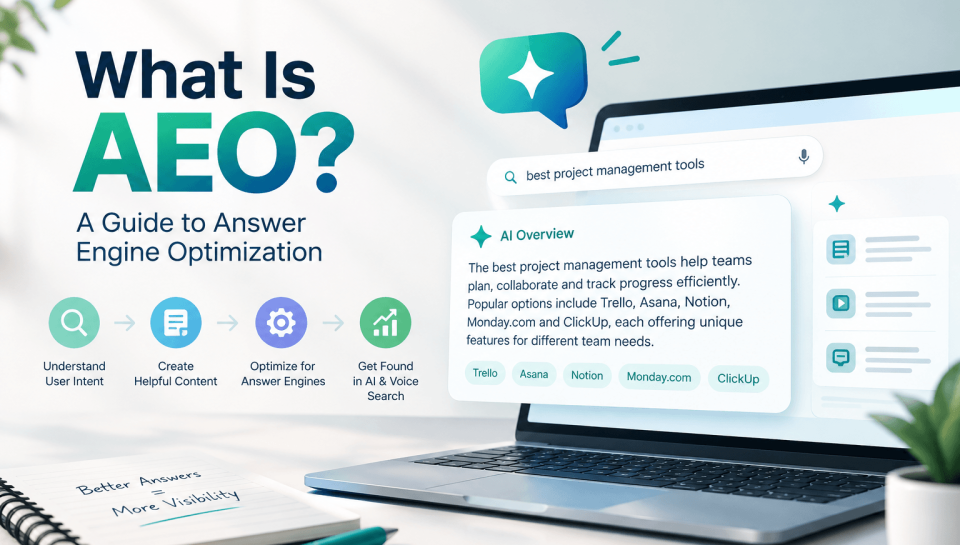
AEO stands for Answer Engine Optimization — the practice of structuring and sourcing your content so AI systems like Google AI Overviews, AI Mode, ChatGPT, Perplexity, Gemini, and Copilot can extract it, trust it, and cite it as the direct answer to a user’s question. Where SEO competes for a position on a results page, AEO competes to be the sentence inside the answer.
- AEO optimizes for being cited, not for being clicked. The unit of optimization is the individual answer — a definition, stat, comparison, or recommendation — not the whole page.
- AEO, GEO, LLMO, and AIO describe roughly the same work. Don’t let vendors sell you four disciplines.
- A strong SEO foundation is still the prerequisite. Research covering Google’s AI Mode found that about 99% of cited URLs also appeared in the organic top 20, though ranking first guarantees nothing.
- There is no special AI markup. Google’s own guidance, updated June 2026, says you don’t need new machine-readable files, AI text files, or Markdown to appear in its generative features. Ahrefs found 97% of llms.txt files received zero requests in a month.
- Citations concentrate heavily in a small set of domains — Reddit, Wikipedia, YouTube, LinkedIn, Forbes — so off-site presence matters more than it did in classic SEO.
- You can finally measure some of it. Google launched generative AI performance reports in Search Console on June 3, 2026, and rolled out worldwide by August 31. They show impressions, not clicks.
What is an Answer Engine?
An answer engine is any system that synthesizes a response instead of returning a list of links. That includes Google’s AI Overviews and AI Mode, ChatGPT, Claude, Gemini, Perplexity, Microsoft Copilot, and voice assistants like Siri and Alexa.
The mechanical difference matters more than the branding. A search engine retrieves and ranks documents, then hands you the list. An answer engine retrieves documents, breaks them into chunks, decides which chunks are relevant and credible, and writes a new passage from them — sometimes citing sources, sometimes not. Your page is an ingredient, not a destination.
That single change is what AEO responds to. If the engine writes the answer, the question is no longer “does my page rank?” It’s “does my sentence survive into the answer, with my brand attached?”
Difference Between SEO and AEO
| SEO | AEO | |
| Goal | Rank a page, earn the click | Be selected and cited inside a generated answer |
| Unit of optimization | The page | The chunk — a definition, stat, table row, step |
| Query shape | Keywords, 1–4 words | Full conversational questions, often 10+ words |
| Authority signals | Backlinks, domain strength | Consistent, corroborated mentions across sources the engine already trusts |
| Result stability | A ranked list, fairly stable | Probabilistic and personalized; two users can get different answers |
| Core metrics | Rankings, sessions, CTR | Citation frequency, share of answer, brand mentions, sentiment, AI referrals |
| Feedback loop | Weeks | Days — and platforms change without notice |
The honest framing: AEO is not a replacement discipline. It’s the same fundamentals — crawlability, clarity, credibility, corroboration — pointed at a system that reads your page instead of listing it. Most of what wins in AEO is competent SEO plus much tighter writing.
AEO vs. GEO vs. LLMO vs. AIO
These terms are largely synonymous in practice:
- AEO (Answer Engine Optimization) — the broadest term; includes featured snippets and voice, which predate LLMs.
- GEO (Generative Engine Optimization) — the term used in the academic literature; narrower, focused on generative systems.
- LLMO / LLM SEO — optimizing specifically for chatbot citations.
- AIO (AI Optimization) — a vendor umbrella term.
Pick one internally and move on. The tactics don’t differ by label, and any agency charging separately for “AEO” and “GEO” is charging twice for one workstream.
Why AEO Matters Now
Zero-click is the default, not the exception. Similarweb’s clickstream data puts the share of Google searches ending without an external click at 68%.
AI answers have reached genuine scale. At I/O 2026, Google reported AI Overviews at more than 2.5 billion monthly active users and AI Mode passing 1 billion monthly users within a year of launch. OpenAI has cited roughly 900 million weekly ChatGPT users.
Question-shaped queries are the most exposed. Pew Research found AI summaries appeared on 53% of searches containing ten or more words and 60% of searches beginning with a question word. That is precisely the query set most informational content targets.
And the click penalty is measurable. In the same Pew analysis, the share of users clicking a traditional result fell from 15% to 8% when an AI summary was present.
Traffic and revenue have decoupled. NerdWallet reported roughly 35% revenue growth in 2024 against a 20% decline in site traffic. Fewer, better-qualified visitors — plus brand presence inside the answer — can outperform raw sessions. This cuts both ways: it’s the strongest argument for AEO and the strongest argument against panicking about traffic charts.
How answer engines choose what to cite
Understanding the pipeline tells you where to intervene.
- Retrieval. The engine runs one or more searches. Google’s AI systems use query fan-out — decomposing your question into several related sub-queries and searching each. So you’re not competing for one query; you’re competing for a cloud of them you never see.
- Chunking. Retrieved pages get split into passages. A passage that depends on three paragraphs of earlier setup usually loses to one that stands alone.
- Selection. The engine scores chunks for relevance, specificity, and credibility. Evidence — numbers, dates, named sources, concrete examples — reads as more usable than assertion.
- Synthesis and attribution. The model writes an answer and attaches citations, often to fewer sources than it actually consulted. Your content can shape an answer without being credited.
Two research findings follow directly from this. CXL’s analysis of 100 Google AI Overview citations found 55% came from the first 30% of the source page — position on the page matters, not just position in the SERP. And Conductor’s research found 57% of AI Overview citations came from outside the organic top 10, which means ranking isn’t a gate, but it also isn’t a guarantee.
What actually works: Eight AEO Practices
1. Answer in the first 50 words, then expand
Put a direct, self-contained answer immediately under each question-shaped heading — roughly 40 to 60 words, no throat-clearing. Then give the detail underneath for the human reader. This is the single highest-leverage change most pages need.
2. Write in extractable chunks
Keep paragraphs to one to three sentences. Make each section independently coherent: if someone pasted it into a chat window with no surrounding context, would it still make sense and still say who it’s from? That’s the test.
3. Use question-shaped headings that match real phrasing
Mine People Also Ask, your site search logs, your sales team’s inbox, and support tickets. Use the user’s phrasing, not your internal jargon. “How much does X cost?” beats “Pricing considerations.”
4. Lead with specifics
Engines reach for what’s quotable: a number, a date, a named comparison, a defined threshold. “Most teams see results quickly” is unusable. “Median time to first citation was 6 to 10 weeks across the pages we restructured” is a sentence an engine can lift.
5. Add tables and ranked lists where they’re honest
One 2026 analysis by Evertune found roughly half of ChatGPT citations were listicles, and about 58% of those were ranked lists. Comparison tables and numbered steps are structurally easy to extract. Don’t force the format — but where a comparison genuinely exists, tabulate it.
6. Make provenance visible
Name the author with real credentials, show a last-updated date, and cite your own sources inline. Engines weigh corroboration; a claim that matches what trusted sources already say, from a page that shows its work, is safer to repeat.
7. Use schema where it describes reality
Article, FAQPage, HowTo, Product, and Organization markup help machines parse structure. But treat schema as clarification, not as a lever — Google is explicit that no special schema is required for its AI features.
8. Build presence off-site
This is where most in-house AEO programs under-invest. See the next section.
What doesn’t work (and what you’ll be sold anyway)
llms.txt. This one deserves its own paragraph because it’s the most oversold tactic in the category. Google’s Gary Illyes said at Search Central Live in July 2025 that Google does not support llms.txt and has no plans to; John Mueller compared it to the old meta keywords tag and confirmed that files on Google’s own properties were a CMS artifact, not an endorsement. The usage data is worse than the official position: Ahrefs found 97% of llms.txt files across 137,000 domains received zero requests in a month, with SEO audit tools accounting for roughly 21% of fetches and actual AI retrieval bots around 1.1%. SE Ranking put adoption at about 10% of 300,000 domains. It also has no blocking power — it is not a robots.txt for AI. Verdict: harmless, near-useless for visibility, occasionally worth shipping if you publish developer documentation that coding agents consume.
“Special AI markup.” Google’s guidance on optimizing for generative AI features, updated June 15, 2026, states plainly that you don’t need new machine-readable files, AI text files, markup, or Markdown to appear in Google Search including its generative capabilities.
A magic word count. There isn’t one. A 3,000-word guide gets cited when the relevant answer is easy to find; a 400-word page fails when it buries the point.
Generic FAQ blocks. Five invented questions at the bottom of every article is formatting, not strategy. Add FAQs where readers genuinely have follow-ups.
Keyword density and entity stuffing. Answer engines operate on meaning, not term frequency. Repetition mostly makes your prose worse, which makes it less quotable.
The off-site problem: citations concentrate
The uncomfortable finding across nearly every citation study is that AI answers draw from a narrow band of sources — narrower than Google’s organic results ever were. Reddit, Wikipedia, YouTube, LinkedIn, and Forbes appear at the top of almost every dataset.
The numbers vary a lot by study, and you should treat any single figure skeptically. One widely cited 2025 analysis of 150,000+ citations put Reddit at 40.1%, Wikipedia at 26.3%, and YouTube at 23.5% across major engines. A 2026 LLM Pulse dataset ranked YouTube first at 26.5%, with Reddit second at 17.4%. Ahrefs’ study of 5.5 million AI Mode queries ranked Wikipedia first and Reddit fourth. Engine-level behavior diverges sharply: Reddit has been measured near 47% of Perplexity’s top sources, while Wikipedia has dominated ChatGPT’s. And shares move fast — Semrush tracked ChatGPT’s Reddit citation rate falling from roughly 60% of responses to around 10% within weeks in late 2025.
What to take from that mess:
- Directionally, community and encyclopedic sources punch far above their weight. Your brand’s presence in those conversations affects what engines say about you.
- Volatility is real. Any strategy built on one platform’s current citation mix will break.
- The practical move is corroboration, not manipulation. Be accurately described in the places engines already read: your Wikipedia entry if you have one, review platforms like G2 and Yelp, industry publications, YouTube, and yes, organic Reddit discussion. Astroturfing subreddits is both against Reddit’s rules and easily detected.
The technical checklist nobody runs first
Before optimizing a single sentence, verify that AI systems can actually read your site. This is where a surprising number of AEO problems actually live.
- Audit robots.txt for AI user agents. GPTBot, OAI-SearchBot, ChatGPT-User, ClaudeBot, PerplexityBot, and Google-Extended are separate agents with separate rules. Many sites blocked them in 2023–2024 during the training-data backlash and never revisited the decision. Note the distinction: blocking a training crawler is a different choice from blocking a retrieval crawler that fetches pages to answer live queries. Blocking the latter removes you from those answers.
- Check the Search Console AI opt-out. The generative AI control lets you exclude your site from AI features. Google says opting out doesn’t affect standard organic rankings — but it does remove you from AI Overviews and AI Mode entirely.
- Test what a bot sees. Content injected client-side by JavaScript is frequently invisible to AI retrievers. Fetch your page without JS and confirm the answer is still there.
- Keep the answer above the fold in the HTML. Given that most cited passages come from the top of the page, content buried under cookie walls, interstitials, or 800 words of preamble is at a structural disadvantage.
- Serve fast, stable HTML. Timeouts on a retrieval fetch mean you simply aren’t a candidate.
How to measure AEO
Google Search Console — Generative AI performance report. Launched June 3, 2026, and rolled out to all sites worldwide by August 31, it gives a dedicated view of impressions in AI Overviews, AI Mode, and generative features in Discover, broken out by page, country, device, and date. Caveat: as of publication, it reports impressions only — no clicks, no CTR, no query data.
GA4 referral traffic. Traffic from chatgpt.com, perplexity.ai, gemini.google.com, and copilot.microsoft.com shows up as referral. Volume is usually small; conversion rate is often notably higher than organic, because the user arrives pre-qualified by the answer.
Prompt tracking tools. Platforms in this category run your priority questions against major engines on a schedule and record whether you’re mentioned, whether you’re cited, and who replaced you. Useful, but remember the data is sampled and synthetic — it’s a panel, not a census.
Branded search volume. If AEO is working and clicks aren’t, the signal often shows up as growth in people searching your brand name directly.
What you can’t measure
Share of answers where your content shaped the response without attribution. Personalized variation across users. Conversations that ended in the chat window. Be honest about this gap rather than inventing an attribution model to cover it.
A sensible KPI set
Track a fixed list of 30–50 priority questions. For each, record: are we mentioned, are we cited, who else is, and has that changed. Then connect the trend to branded demand, AI referral conversions, and pipeline — not to citation count as a vanity metric.
A 90-day starting plan
Days 1–30 — Baseline and unblock. Audit robots.txt and the AI opt-out toggle. Pick 30–50 questions that matter commercially. Run them through ChatGPT, Perplexity, Gemini, and Google AI Mode by hand and record who gets cited. Note what the cited sources do that you don’t.
Days 31–60 — Restructure your best pages. Take the 10–20 pages that already rank well and rewrite the openings: direct answer up top, question-shaped H2s, atomic paragraphs, a comparison table where one is warranted, visible author and update date. Don’t start with new content; start with pages that already have authority.
Days 61–90 — Off-site and measure. Fix how you’re described in the places engines already trust — review platforms, industry directories, your own documentation, relevant communities. Then re-run the same question set and compare. Keep the methodology identical, or the comparison is worthless.
The skeptical case for AEO
Worth saying plainly, since most AEO content is published by companies selling AEO software:
AI referral traffic is still small for most sites — typically low single-digit percentages of sessions, even in 2026. The measurement is immature and partly synthetic. The tactics that work are mostly good writing and good SEO under a new name. And the category is full of invented metrics designed to justify subscriptions.
The counterargument is also real: the queries most affected are informational and question-shaped, which is exactly where most content marketing lives; the visibility you lose is invisible in your analytics; and the fixes are cheap because they’re mostly editorial.
The reasonable position is neither panic nor dismissal. Do the work — it improves your pages for humans regardless — and refuse to pay for AEO as though it were a separate discipline from the content quality you should have been enforcing anyway.
Frequently asked questions
What does AEO stand for? AEO stands for Answer Engine Optimization: optimizing content so AI-powered answer engines can find, understand, trust, and cite it in generated responses. In stock listings, AEO is also the ticker for American Eagle Outfitters.
Is AEO the same as GEO? Effectively yes. GEO (Generative Engine Optimization) is the term used in academic research and focuses on generative systems, while AEO is broader and includes featured snippets and voice assistants. The practical tactics are the same.
Will AEO replace SEO? No. AEO depends on SEO. Research on Google AI Mode found roughly 99% of cited URLs also appeared in the organic top 20. If a page can’t be crawled, indexed, and ranked, it generally can’t be cited either.
Do I need llms.txt for AEO? No. Google has said on the record that it doesn’t use the file and doesn’t plan to, and its June 2026 guidance says no special machine-readable files are needed. Ahrefs found 97% of llms.txt files received zero requests in a month. It may be worth shipping if you publish developer docs that AI coding assistants fetch.
Does schema markup improve AI citations? Schema helps machines parse structure and is worth implementing correctly, but Google states no special schema is required for its generative AI features. Treat it as hygiene, not as a citation switch.
How long does AEO take to work? Restructured pages can start appearing in answers within a few weeks, because retrieval is live rather than dependent on a slow index refresh. Building the off-site corroboration that drives consistent citation takes months.
How do I know if AEO is working? Use Search Console’s generative AI performance report for impressions in Google’s AI features, GA4 referral data for AI-sourced sessions, and a tracked question set you re-run on a fixed schedule. Watch branded search volume as a lagging indicator.
Should I block AI crawlers? It depends on your business model. Publishers with licensing leverage may choose to. But understand the distinction: blocking retrieval agents like OAI-SearchBot or PerplexityBot removes you from live AI answers, while blocking training crawlers only affects future model training. Most brands that sell something want to be in the answers.
Does AEO work for local businesses? Yes, and often faster. Answer engines lean on structured local data and reviews, so accurate listings, consistent NAP details, and a healthy review profile do most of the work.
Final Thoughts
AEO is what SEO looks like when the search engine stops handing over a list and starts writing the answer itself. The winning page is no longer the most comprehensive one — it’s the clearest, best-evidenced, easiest-to-lift one, published somewhere the engine already trusts.
Almost everything that works is unglamorous: answer the question in the first sentence, keep paragraphs short, cite real numbers, show who wrote it, make sure the crawlers aren’t blocked, and be accurately described elsewhere on the web. The tactics being sold as proprietary AI optimization mostly aren’t. Start with the audit, fix the pages you already rank with, and measure against a question set you’ll still be running next quarter.