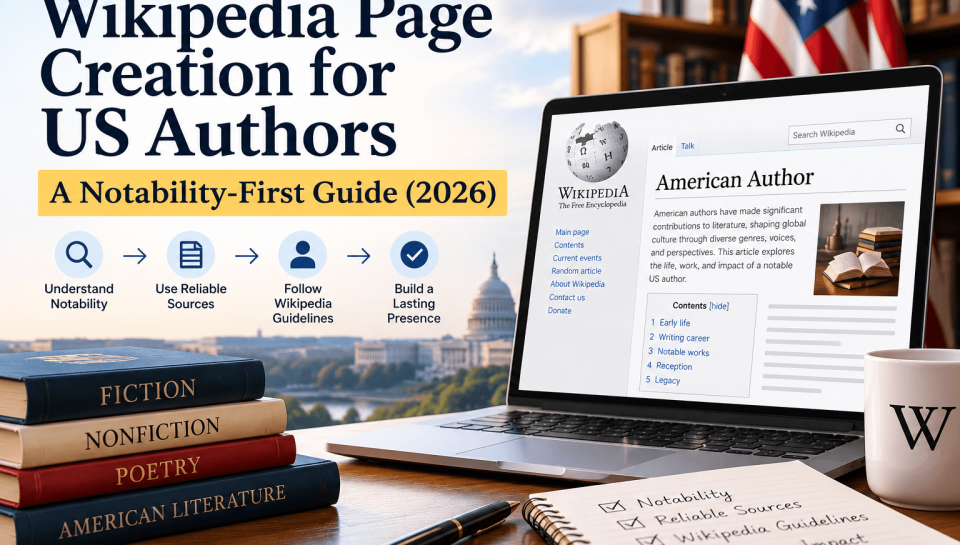
Wikipedia page creation for US authors starts with notability, not writing. An author qualifies when independent, reliable sources such as major newspaper reviews, in-depth profiles, or scholarly analysis have covered them and their work significantly. To get a page: (1) check whether you or your book meets Wikipedia’s author or book guideline, (2) list your independent sources, (3) disclose any personal or paid connection, (4) write a neutral, fully cited draft by hand, (5) submit it through Articles for Creation, and (6) respond to reviewer feedback. Review takes about a month on average, and approval is never guaranteed.
Selling a lot of books doesn’t get you a Wikipedia page. Neither does having a publisher, a strong Amazon rating, or fifty titles on your shelf. Wikipedia judges authors by a different yardstick: whether independent critics, journalists, and scholars have written in depth about you and your work.
That gap between publishing success and Wikipedia eligibility is why so many author drafts get declined. In a 2026 audit of more than 1,000 draft submissions, roughly two-thirds were declined, and the most common reason was a failure to show notability.
This guide is written for US authors, agents, and publicists. It explains the two separate tests Wikipedia applies (one for the author, one for the book), which sources count and which quietly don’t, how self-published authors fit in, what the conflict-of-interest and AI rules mean for you, and how to decide between doing it yourself and hiring help.
Why Sales and Awards Stickers Don’t Count
Publishing runs on sales, launch buzz, and reader reviews. Wikipedia runs on a single question: has anyone independent of you written about this subject in a substantial, reliable way? Wikipedia’s own guideline says self-promotion, autobiography, press releases, advertisements, and paid material are not valid routes to an article.
For an author, that means several things you may have worked hard on carry little or no weight:
- Reader reviews on Amazon or Goodreads
- Your own website, your publisher’s page, and the back-cover copy
- Press releases and sponsored features
- Awards you paid to enter
- Social media following
None of these are worthless for your career. They just aren’t evidence of notability.
Is a Wikipedia Page Worth It for an Author?
Potential upsides
- Wikipedia often ranks near the top for name searches, so it can become a first stop for readers, librarians, event organizers, and journalists.
- It gives interviewers and booksellers a neutral summary of your career.
- It can link your books, awards, and critical reception in one place.
Real downsides
- You don’t control it. Anyone can edit it, including adding critical reviews of your work.
- It can be nominated for deletion at any time, even after publication.
- It needs monitoring, and edits from people connected to the subject draw extra scrutiny.
- Wikipedia’s links to your site are generally “nofollow,” so don’t count on a direct SEO boost.
If the goal is book promotion, Wikipedia is the wrong channel. If you are notable and want an accurate public record, it can be worthwhile.
Do You Qualify? Wikipedia Runs Two Different Tests
Most guides blur these together. Wikipedia treats you and your book as separate subjects with separate guidelines. Either can qualify without the other.
The author test: creative-professional criteria
Wikipedia groups authors with other creative professionals. According to the biography guideline, a creative professional is presumed notable when reliable, independent sources show at least one of the following:
| Criterion | In plain English |
| Important figure | Peers or successors widely cite you or regard you as an important figure in your field. |
| Original contribution | You’re known for originating a significant new concept, theory, or technique. |
| Significant work | You created (or played a major role in creating) a significant or well-known work, or body of work, that has been the subject of an independent book or feature-length film, or of multiple independent periodical articles or reviews. |
| Critical attention | Your work has won significant critical attention. (The same criterion also covers monuments, exhibitions, and museum collections, which mostly apply to visual artists.) |
For most working novelists and nonfiction authors, the third and fourth criteria are where the case gets made: a body of work that has drawn multiple independent reviews and articles.
Notice what’s not on the list: sales, number of books, and a specific number of awards. A well-known, significant literary prize can help under Wikipedia’s separate general biography guideline, but it isn’t one of the author criteria. Check the current wording of the guideline before you build your case, because guidelines change.
The book test: notability for books
Books have their own guideline. A book is presumed notable if it meets at least one of five criteria (Wikipedia: Notability (books)). The most commonly used one requires that the book has been the subject of two or more non-trivial published works in sources independent of the book itself. That can include newspaper articles, other books, television documentaries, bestseller lists, and reviews. The other criteria cover major literary awards, significant contributions to a field or movement, classroom study at multiple schools or universities, and authors so historically significant that their works are notable.
Three details matter to authors:
- Self-publication and vanity presses don’t correlate with notability. Self-published books aren’t barred, but self-publishing doesn’t help.
- Publisher-controlled material is excluded. Reprints of press releases, flap copy, and anything where the author, publisher, or agent talks up the book don’t count.
- Unpublished books generally don’t qualify. Don’t plan a page for an upcoming release. The guideline’s criteria don’t apply to books not yet published.
A book that qualifies also has to support a real article, not a plot summary alone.
The fallback: general notability
If you don’t fit an author guideline, the general standard still applies: significant coverage in reliable sources independent of the subject. The same idea sits underneath everything above.
What Counts, and What Doesn’t, for Authors
| Source | Helps establish notability? | Why |
| Book review by a staff critic at a major newspaper or magazine | Usually yes | Independent, editorial oversight, about your work |
| In-depth profile by a staff journalist | Usually yes | About you, independent |
| Scholarly article or book analyzing your work | Yes | Independent secondary source |
| Trade reviews (for example, Publishers Weekly, Booklist, Library Journal) | Reliable, but weight is debated | Some experienced editors argue these outlets review so many books that a review says little about significance |
| Paid review programs (such as indie review services) | Unlikely | You paid for the review, so it isn’t independent of you |
| Q&A interviews and podcasts | Weak | The substance is your own words |
| Your site, publisher page, flap copy, press releases | No | Not independent |
| Amazon, Goodreads, reader blogs | No | User-generated and unedited |
| Pay-to-enter contests and small awards | No | No meaningful independent selection |
| Bestseller lists | Can support a book, but not sufficient alone | The books guideline lists them among published works, but coverage still needs depth |
Two rules of thumb: the coverage should be about you or your book rather than a passing mention, and it should come from an outlet with real editorial standards.
A note on trade reviews: the debate among editors is about weight, not reliability. Treat a trade review as one useful reference, not a magic ticket, and pair it with coverage from general-interest outlets.
Special Cases for US Authors
| If you are… | What to expect |
| Self-published or indie | Same tests, no shortcut. Paid reviews and reader ratings won’t carry the case. Focus on earned coverage from independent outlets. |
| A debut author | You rarely qualify as an author yet. A single book can qualify on its own if it draws multiple non-trivial independent reviews or articles. |
| Traditionally published, midlist | A publisher doesn’t create notability. You need the reviews and features. |
| A nonfiction expert or memoirist | You may qualify through your work in another field (business, medicine, law, journalism) as well as your books. Check the guideline for your profession, and consider our professional Wikipedia page guide. |
| An academic author | Wikipedia has a separate academics guideline focused on scholarly impact. |
| A journalist or screenwriter | The same creative-professional criteria apply. |
A Six-Question Author Self-Check
- Can I name several reviews, features, or scholarly discussions of my work published by outlets with editorial standards?
- Did I earn that coverage, rather than pay for it or write it myself?
- Is the coverage in-depth, with my name or book as the main subject?
- Is it spread across more than one book or more than one moment?
- Have I checked whether a page about me (or my book) exists, or was deleted before?
- Am I claiming notability from sales, ratings, or awards that don’t meet the bar?
If the first two answers are “no,” read the section on building notability below before you draft anything.
Your Real Odds: What the Data Shows
Wikipedia doesn’t publish an author-specific approval rate. One useful dataset comes from Lumino Digital, a Wikipedia consulting firm, which audited 1,009 Articles for Creation submissions (Lumino Digital, 2026):
| Finding | Result |
| Submissions declined | 68% |
| Declines citing lack of notability (most common reason) | 57% |
| Approval rate: Arts & Culture (highest category) | 48% |
| Approval rate: Business (lowest category) | 16% |
| Average review time | About 30 days |
| Drafts flagged by reviewers for suspected AI use | 16% |
How to read this. The public summary doesn’t break out authors, so treat Arts & Culture as a directional signal, not a promise. The sample came from two weeks in fall 2025, and each result reflects a specific submission rather than a page’s outcome: some declined drafts were later fixed and approved, and some approved pages were later deleted. The lesson holds regardless: notability is where drafts fail, so it’s where your preparation should go.
Can You Write Your Own Author Page? Conflict of Interest Rules
Wikipedia doesn’t ban you from writing about yourself, but its conflict-of-interest guideline strongly discourages it. If you are the author, or you are paid to work on behalf of an author, these rules apply:
- Disclose. Under the Wikimedia Foundation’s Terms of Use, paid editors must disclose their employer, client, and affiliation, whether payment comes directly or through an employer.
- Publicists and agents are in scope. Guidance discussions on English Wikipedia treat people paid for publicity work as paid editors, even if they aren’t paid specifically to edit Wikipedia. If you’re a publicist, agent, or publisher’s marketing lead, assume the disclosure rules apply to you.
- Nobody can guarantee an outcome. Paid editors can’t promise an article will be published or kept, and neither the client nor the editor owns the article.
- Failing to disclose has consequences. Editors who don’t disclose paid contributions are prohibited from editing.
- Use the review process. The guideline advises editors with a financial conflict to avoid direct article editing, which is why Articles for Creation exists.
Family members and close friends also have a conflict of interest, though the paid-disclosure rule is specifically about compensation. When in doubt, disclose.
AI-Written Drafts Are Now Prohibited
In March 2026, English Wikipedia’s editors adopted a policy prohibiting the use of large language models to generate or rewrite article content. Two narrow exceptions exist: basic copyediting of your own writing, and translation from another language edition, each with human review.
For authors, who already write for a living and may be tempted to lean on AI for a bio or book summary, this matters:
- A draft that reads as machine-generated invites extra scrutiny, and obvious signs (leftover chatbot phrasing, placeholders, references that don’t exist) can get it deleted quickly.
- Fabricated citations are a special hazard. Every source must exist and support the sentence it’s attached to.
- Any service promising an AI-written Wikipedia page is selling a liability.
How to Create a Wikipedia Page for an Author: Step by Step
- Search for existing pages. Check for an existing article, draft, or redirect about you and about each of your books. Look at the deletion log too; a previously deleted page shows what reviewers objected to.
- Build a source ledger. For every piece of coverage, record the title, outlet, author, date, link, and how much of it is about you or the book. Cut anything that fails the table above. What’s left is your real case.
- Decide what you’re actually creating. An author page, a page for one specific book, or neither. A single notable book may qualify even when the author doesn’t.
- Choose who writes it. DIY, disclosed freelancer, or agency (compare them below). Whoever writes it must understand Wikipedia’s rules.
- Create an account and practice. Accounts more than four days old with at least 10 edits are autoconfirmed, but making small, uncontroversial edits first is worth the time.
- Draft in your sandbox. Use a neutral, encyclopedic voice, and cite every claim to an independent, reliable source.
- Disclose your connection. Add a conflict-of-interest or paid-contribution disclosure to your user page and the draft’s Talk page before submitting.
- Submit through Articles for Creation. An experienced volunteer reviews it. Expect about a month.
- Respond to feedback. If declined, fix the root cause. A notability decline usually means you need more coverage, not better wording.
- After approval, monitor and stay hands-off. Suggest changes on the Talk page rather than editing your own article.
A photo tip: only upload a headshot if you own the rights and are willing to release it under a free license. If not, skip it rather than risk a copyright deletion.
What a Good Author Page Looks Like
A typical author article opens with a short lead saying who the author is, what they write, and why they’re notable. Then it moves through early life (only if independently documented), career, critical reception, awards, a list of works, and references. The reception section is where the notability case becomes visible: it should report what independent critics said, with citations.
| Promotional (gets flagged) | Neutral (survives review) |
| “Daniel Reyes is a bestselling, award-winning novelist whose gripping thrillers keep readers hooked.” | “Daniel Reyes (born 1979) is an American novelist. His debut novel, [Title] (2016), was published by [Publisher].[1]” |
| “His masterpiece was hailed by critics everywhere.” | “Reviewing the novel for [Outlet], [Critic] wrote that it [neutral paraphrase of the review].[2]” |
| “He has sold over a million copies.” | “According to [reliable source], the novel had sold [figure] copies by [year].[3]” |
The pattern: specific, dated facts and a citation for each claim, with no praise words. Wikipedia reports what independent sources say. It doesn’t say what’s impressive.
DIY, Freelancer, or Agency?
| DIY | Freelancer | Agency | |
| Cost | Your time | Varies widely | Typically the highest |
| Wikipedia experience | Only what you learn | Varies; verify it | Varies; ask for specifics |
| Conflict-of-interest risk | Highest | Must disclose paid status | Must disclose paid status |
| Best for | Clearly notable authors with time to learn | Well-scoped drafting and sourcing help | Complex cases and ongoing monitoring |
Prices vary widely. As one public data point, a US agency lists starting prices of $2,000 for individuals and $5,000 or more for companies. Treat it as an example, not a benchmark, and get written quotes.
Red flags when hiring a Wikipedia writer for an author page
- Guaranteed approval. Wikipedia’s guidance says paid editors cannot guarantee an outcome.
- No mention of disclosure. Legitimate paid editing is disclosed.
- No upfront notability assessment. A responsible provider will tell you “not yet” when that’s the honest answer.
- “Insider” or administrator connections. Reviews are done by independent volunteers.
- AI-generated drafts. Prohibited under the March 2026 policy.
- Vague answers about who edits on your behalf and what they’ve published before.
Questions to ask before you sign
- Will you assess my notability first, and tell me if I don’t qualify?
- How will you disclose the paid relationship?
- Who writes the draft, and is any AI involved?
- What happens if the draft is declined or later deleted?
- What does monitoring cost, and what does it include?
Not Notable Yet? Build Coverage the Right Way
Publishing too early is the costliest mistake, because a page deleted for lack of notability is harder to recreate. If your list of independent sources is thin, spend your energy on earning real coverage first:
- Pursue editorial reviews. Submit to established outlets and trade reviewers that don’t charge for coverage. Check each outlet’s submission guidelines, since many want advance copies well ahead of publication.
- Pitch features, not press releases. Offer journalists a real angle: original research, an unusual backstory, a timely expertise.
- Seek scholarly attention. Academic citations, syllabi, and analysis in journals or books are strong independent evidence.
- Enter prizes that select independently, not pay-to-enter contests.
- Be a source. Become the expert staff journalists quote on your subject; profiles often follow.
Meanwhile, use alternatives. Wikidata has lower barriers than Wikipedia, and a well-built author website with clear “about” information and structured data helps search engines and AI assistants understand who you are. None of it replaces Wikipedia, but it’s an honest way to build your footprint while you build the case.
Common Mistakes That Sink Author Drafts
- Submitting before the coverage exists.
- Leaning on sales, ratings, and reader reviews as proof of importance.
- Citing your own site, publisher page, or press releases.
- Using paid review programs as evidence of critical attention.
- Writing promotional prose (“bestselling,” “acclaimed”) without cited context.
- Listing every book and event instead of what independent sources covered.
- Creating a page for an unpublished book.
- Skipping disclosure of a personal or paid connection.
- Using AI to draft.
- Resubmitting an unchanged draft after a decline.
After Your Page Goes Live
Approval isn’t the finish line. Anyone can edit the page; new reviews and awards will need adding over time, and pages can be nominated for deletion years later. If you have a conflict of interest, don’t rewrite substantive content yourself. Post factual corrections and updates on the Talk page with sources, disclose your connection, and let independent editors decide. Set up a way to watch the page for changes, and respond calmly, with citations, if someone challenges it.
Frequently Asked Questions
Can an author create their own Wikipedia page?
Yes, but it’s discouraged. You must follow Wikipedia’s conflict-of-interest guideline and disclose your connection. Authors who write their own pages are more likely to have them flagged or declined.
How many books do I need to have published to get a Wikipedia page?
There is no book count. Wikipedia looks at whether independent, reliable sources have covered you or your work in depth. One book with several substantial independent reviews can qualify, while many books with no independent coverage won’t.
Can a self-published author get a Wikipedia page?
Yes, in principle. Self-publishing doesn’t disqualify you, but it also doesn’t help. You need the same independent coverage as any other author, and paid reviews or reader ratings won’t count.
Do Amazon or Goodreads reviews count?
No. User-generated reviews aren’t reliable sources for establishing notability.
Does a bestseller list or an award make me notable?
Not automatically. Bestseller lists can support a book’s case under the books guideline, and major, well-known prizes can help, but Wikipedia still wants independent coverage with real depth.
How much does a Wikipedia page for an author cost?
There is no fixed rate. DIY costs time only. Agencies vary widely; one US provider lists $2,000 and up for individuals. Get a written quote and confirm the work will be disclosed.
How long does it take?
Review alone averaged about 30 days in a 2026 audit of 1,009 submissions. Add time for gathering sources and drafting, and the whole process often takes months.
Can I use ChatGPT or another AI to write my author page?
Not for article content. English Wikipedia prohibits using large language models to generate or rewrite articles, with narrow exceptions for copyediting your own writing and for translation, both with human review.
Conclusion
A Wikipedia page for an author isn’t something you buy, and it isn’t something you write your way into. It’s something you qualify for by being covered, in depth, by independent critics, journalists, and scholars, and then presented neutrally and transparently. Check the author and book tests first, disclose any connection, write by hand, and expect a real review. If you’re not there yet, the most valuable move is to build the coverage that makes a page possible.