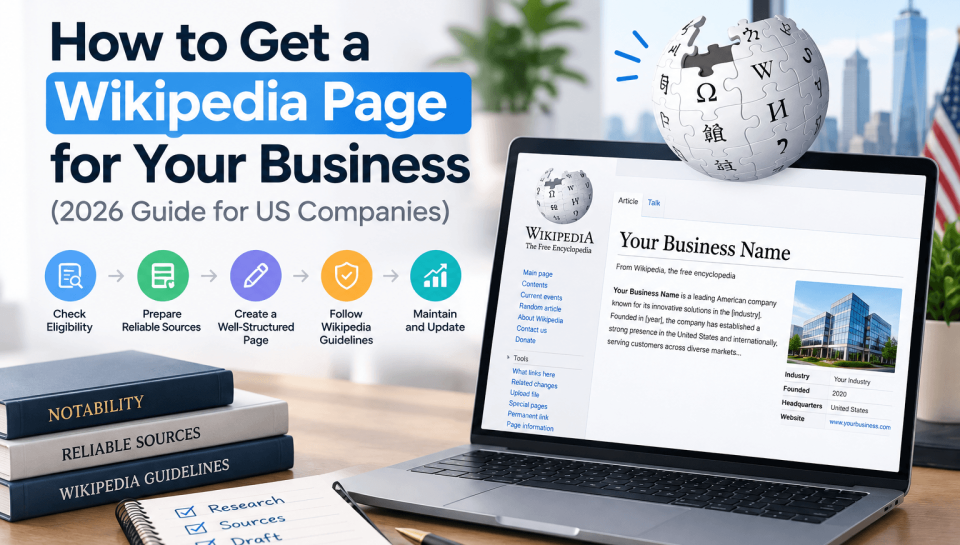
You don’t “get” a Wikipedia page so much as qualify for one. A business earns an article when reliable, independent sources have already covered it in depth. To get one, you (1) confirm no page or draft exists, (2) check that you meet Wikipedia’s notability standard, (3) have a neutral, disclosed editor write a sourced draft rather than writing it yourself, (4) submit it through Articles for Creation, and (5) respond to reviewer feedback. Review typically takes weeks to months, and no one can guarantee approval.
Can Any Business Have a Wikipedia Page?
No, and that’s the part most guides bury.
Wikipedia isn’t a business directory. It’s an encyclopedia, and it covers a company only when independent coverage proves the company is worth documenting. Being established, profitable, or well-reviewed doesn’t count on its own. A company that has operated for 20 years without attracting analytical press coverage won’t qualify. A two-year-old startup with several substantial features in respected publications might.
Size matters less than sourcing. A regional business with solid coverage in reliable local and trade press can qualify. A large business with only press releases and directory listings usually can’t.
So the real question is: has the outside world already written about you in depth?
Step 1: Check Whether a Page or Draft Already Exists
Before anything else, search Wikipedia for your company name, including variations and former names. Also check:
- Deleted pages. Wikipedia’s public deletion logs show whether a page about your company was previously created and removed. A deletion history doesn’t end your chances, but you need to understand why it happened before trying again.
- Existing drafts. Someone may have started one. Search the Draft namespace.
- Mentions in other articles. If your company is discussed inside a broader article (an industry, a founder, an acquisition), that context can help or affect how a standalone article is received.
Step 2: Test Your Notability Honestly
Wikipedia’s baseline is the General Notability Guideline: a topic is presumed notable when it has received significant coverage in reliable sources that are independent of the subject. Companies are also assessed against a stricter guideline for organizations and companies, which is skeptical of routine business coverage.
Three things trip up business owners most often:
- Press releases never count. Wikipedia treats them as coming from the company, even when a major outlet republishes them. Close rewrites of press releases don’t count as sustained coverage either.
- Routine coverage isn’t enough. Funding announcements, product launches, hires, and award listings show a company exists. They rarely show it’s notable.
- Notability isn’t inherited. Working with a famous client, investor, or partner doesn’t make you notable.
There’s no official minimum number of sources. In practice, editors want several strong ones, and a single article leaves a page fragile in any deletion discussion.
A 10-minute self-check: List every article that’s substantially about your company from a publication with real editorial standards. Cross out anything you or your PR team supplied. If fewer than three items survive, you’re probably not ready.
If you’re not ready, that’s useful to know now. A rejected or deleted draft can make later attempts harder, so it’s smarter to earn coverage first (see the section below).
Step 3: Decide Who Writes It (This Is Where Most Guides Go Wrong)
Many how-to guides tell you to create an account, make ten quick edits to become “autoconfirmed,” and then write your own page. That advice ignores the rule that matters most.
Wikipedia’s conflict-of-interest guideline strongly discourages editing about your own organization. If you have a connection, the accepted route is to draft the article and submit it through the Articles for Creation process rather than publishing directly, and to disclose the connection. You should not directly edit an article about your own company once it’s live; you propose changes on the talk page instead.
If you’re paid, or if writing this is part of your job, disclosure isn’t optional. The Wikimedia Foundation’s Terms of Use require paid editors to disclose their employer, client, and affiliation. Wikipedia’s Articles for Creation guidance repeats this, and it also says drafts generated entirely by large language models will be rejected.
Practical consequences:
- Disclose everything. State the connection on your user page or the draft’s talk page.
- Don’t use a company name as your username. Accounts that imply shared use or reflect a company name aren’t appropriate.
- Don’t recruit friends, employees, or freelancers to edit “independently.” Coordinating undisclosed editors looks like manipulation and gets accounts blocked and pages reverted.
- Don’t paste in AI-generated text. It’s more likely to be rejected, and it tends to invent claims that fail verification.
- Don’t farm edits to game your way in. Autoconfirmed status is a technical threshold, not a substitute for a neutral perspective.
The cleanest approach is to work with a neutral third party, such as an experienced Wikipedia editor who discloses the paid relationship, or to hire a consultant to coach your in-house team through the process.
Step 4: Build Your Source List Before Writing a Word
Sources are the article. Editors will judge your draft by its references first.
Build a table like this:
Prioritize:
- In-depth features and profiles in reputable outlets
- Books and academic or industry studies that discuss your company
- Coverage of major events: acquisitions, litigation, regulatory actions, product impact
- Reliable coverage over a span of time, not a one-week news spike
Include sources that reflect reality, including criticism or controversy when reliably reported. An article that shows only the good news reads as promotion, and reviewers notice.
Step 5: Write a Draft in Wikipedia’s Voice
Write it as an encyclopedia entry, not a brand profile.
A typical company article includes:
- Lead paragraph: what the company is, where it’s based, what it’s known for, in two to four neutral sentences
- History: founding, major milestones, funding, acquisitions, leadership changes, only as covered by independent sources
- Operations or products: a brief factual description, not a feature list
- Reception or impact: how independent sources have characterized the company, including criticism
- References: inline citations for every claim a reader could challenge
- Infobox: founded, headquarters, industry, key people, and similar facts, sourced
Language to avoid: “leading,” “innovative,” “world-class,” “cutting-edge,” “trusted by thousands,” calls to action, and anything that sounds like a sales page.
Language to use: dated, attributable facts. “The company raised a $12 million Series A round in 2023, according to [Publication]” beats “The company is rapidly growing.”
Also remember:
- Don’t link to your own commercial site as a promotional tool. An official-website link in the infobox is normal.
- Don’t copy text from your website or press materials. Copyright and close-paraphrase problems get drafts declined.
- Every non-trivial sentence should trace to a source.
Step 6: Submit Through Articles for Creation
Articles for Creation (AfC) is Wikipedia’s review process for new drafts. A volunteer reviewer checks your draft against notability, neutrality, and sourcing standards, then accepts it, declines it with feedback, or rejects it.
- Create the draft using the Article Wizard or your sandbox.
- Add the disclosure on the draft’s talk page.
- Click “Submit for review.”
- Wait. Volunteers work through the queue in their own time, and paying doesn’t change your position.
- Read the feedback carefully if it’s declined. Fix the stated problems before resubmitting.
Don’t resubmit repeatedly without addressing feedback. Every unaddressed resubmission wastes reviewers’ time and hurts your credibility.
Why Business Drafts Get Declined
- Not enough independent coverage. The most common reason.
- Promotional tone. Marketing language, unsupported superlatives, or a “why choose us” feel.
- Sources that don’t count. Press releases, self-published material, sponsored content, interviews.
- Undisclosed conflict of interest. Reviewers notice patterns quickly.
- Copied text. Drafts lifted from your website or brochures.
- Too thin. A few sentences and a link isn’t an encyclopedia article.
- AI-written prose. Fabricated details and generic language don’t survive verification.
How Long Does It Take, and What Does It Cost?
Timeline. Drafting and client review take a few days to a few weeks. The AfC review is the uncertain part: published estimates run from a few weeks to several months, and revisions add time. Anyone promising a live page by a fixed date is guessing.
Cost.
Very low prices tend to mean templated drafts and no monitoring, and very high prices don’t guarantee approval either.
What to Do If Your Business Isn’t Notable Yet
A “not yet” isn’t a dead end. It’s a to-do list.
- Earn independent coverage the honest way. Pitch newsworthy stories: original research, customer impact, notable funding, legal or regulatory milestones, community or industry firsts. Journalists respond to news, not promotion.
- Focus on depth, not volume. One substantial feature outweighs ten passing mentions.
- Contribute expertise. Data, studies, and commentary that reporters cite can lead to coverage in which your company is discussed, not just quoted.
- Document what you can. Keep a dated file of coverage so you can assess readiness later.
- Re-check every six to twelve months.
Meanwhile, control what you can: an accurate website, consistent business listings, structured data, and a strong Google Business Profile. These don’t substitute for Wikipedia, but they help searchers and AI systems find accurate information about you.
After Your Page Goes Live
- Expect other editors to change it. That’s how Wikipedia works.
- Don’t edit it directly if you have a conflict of interest. Post proposed changes with sources on the talk page using the edit request process.
- Monitor the page. Watch for vandalism, tags, and deletion nominations.
- Update it when new independent coverage appears. Requests should cite new sources, and be specific and neutral.
- Never try to remove criticism that reliable sources support. It backfires.
Will a Wikipedia Page Help Your Business?
It can help people verify who you are, and Wikipedia pages often rank prominently for a company’s name. Don’t treat it as a marketing channel, though. Wikipedia links are nofollow, the page can’t advertise, and other editors control what it says. Think of it as a credibility and reference asset, not a lead-generation tool.
Need Help? How Write and Rank Can Support You
- Notability assessment first. We tell you honestly whether you’re ready, and what coverage would change that.
- Disclosed paid editing. We follow Wikimedia’s Terms of Use and English Wikipedia’s paid-editing rules on every project.
- Neutral, source-led drafting. Every claim tied to a reliable, independent source.
- No guarantees we can’t keep. Approval is decided by Wikipedia’s volunteers.
Frequently Asked Questions
Can I create a Wikipedia page for my own business?
Technically anyone can submit a draft, but Wikipedia strongly discourages people from writing about their own organization. If you do, disclose your connection and submit through Articles for Creation instead of publishing directly.
How do I know if my business qualifies?
You need significant coverage in reliable sources that are independent of you. Press releases, your own site, interviews you controlled, and directory listings don’t count.
How many sources do I need?
There’s no official number. Editors generally expect several strong, independent, in-depth sources. A single article is risky.
How long does approval take?
Weeks to several months, depending on the review queue and how many revisions are needed. Payment can’t speed up the queue.
How much does it cost?
Doing it yourself is free. Professional services commonly run about $1,000 to $2,500 for a typical page, with a much wider range in the market.
Do I have to disclose if I hire someone?
Yes. Paid editors must disclose their employer, client, and affiliation under the Wikimedia Foundation’s Terms of Use.
Can I use AI to write the page?
It’s a bad idea. Articles for Creation rejects drafts generated entirely by AI, and AI tends to invent claims that can’t be verified.
What if my page was deleted before?
Find out why, fix the underlying problem (usually notability or tone), and earn new independent coverage before trying again.
Will Wikipedia improve my SEO?
It can improve visibility for your brand name, but its links are nofollow and the page can’t be used to promote you. Don’t pursue a page as a link-building tactic.
Can I update my page after it’s published?
If you have a conflict of interest, propose changes on the article’s talk page with reliable sources and let independent editors decide.
The Bottom Line
The path to a Wikipedia page for your business runs through independent coverage, neutral writing, and full disclosure. Skip any of those and the page either never appears or doesn’t last. If you’re not sure where you stand, get an honest assessment before you invest in a draft.